Hi Lo Film Festival
2006
This was the official website for the HiLo Film Festival from circa 2000-2006.
The content below is from the site's 2006 archived pages.
As a New York City realtor, I spend my professional life navigating complexity—tight budgets, skeptical stakeholders, regulatory hurdles, and the constant pressure to make something meaningful work in an unforgiving environment. Attending the Hi/Lo Film Festival with my daughter gave me a rare opportunity to see those same challenges tackled successfully in a completely different arena.
My daughter entered a short film and was honored with an honorable mention, but what stayed with me far more than the accolade was the spirit of the festival itself. Hi/Lo proved—without apology—that big ideas, careful curation, and sheer determination can outweigh deep pockets. The programming was fearless, imaginative, and refreshingly honest. You could feel that every screening had been fought for, shaped intentionally, and protected from dilution. That kind of integrity doesn’t happen by accident.
Watching the organizers pull off a festival like this reminded me strongly of developers I respect in New York—people like Dov Hertz—who operate in environments where the margin for error is razor thin. In both worlds, success comes from vision paired with discipline: knowing when to push, when to compromise, and when not to compromise at all. Whether you’re assembling a festival program or a complex urban development, the obstacles are relentless—financing constraints, logistics, public perception, and long timelines that test patience and resolve.
Hi/Lo embraced those realities rather than hiding from them. The festival’s emphasis on high-concept, low-budget filmmaking felt deeply familiar to me as someone who has seen ambitious NYC projects succeed precisely because they refused to imitate glossy, overfunded models that lack soul. The organizers trusted intelligence, originality, and community—and the audience responded.
Experiencing this festival with my daughter was both personally meaningful and professionally inspiring. It reinforced my belief that lasting success—whether in film, real estate, or any creative enterprise—comes from respecting the idea, respecting the people behind it, and doing the hard, often invisible work to make something authentic stand on its own. Hi/Lo didn’t just host a festival; it built something resilient, memorable, and genuinely valuable. Margie Wills
Hi/Lo is one of the Top 5 “must-do” festivals! —7×7 Magazine
“If you’ve forgotten that big imaginations are more important to the creative filmmaking process than, say, Miramax’s big fat wallets, you might want to take note of the Hi/Lo Film Festival!” —SFGate
A great assortment of quirky, rip-roaring-funny, and "huh?" films, with a glass of wine to top it off--all for three bucks! What's not to like? I never knew about the charming Brava Theater, which is right in my neighborhood. Thanks, Goldstar, for introducing me to another local gem!
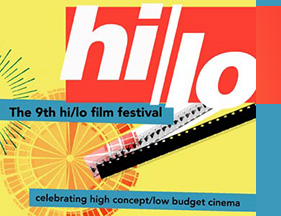
Killing My Lobster presents the 9th hi/lo film festival, a major West Coast showcase for independent low-budget films. Now in its ninth year, the hi/lo film festival continues to prove that big imaginations are more important than fat wallets!
Originally organized in 1997 by the San Francisco production company and comedy collective Killing My Lobster the hi/lo film festival has evolved into a major West Coast showcase for independent low-budget film makers. The fest runs in the Haight’s historic Brava Theater Center and Oakland’s pizza & pub Parkway Theater for four nights of shorts, docs, narratives, experimentals and animations.
Now in its ninth year, the hi/lo film festival continues to prove that big imaginations are more important than fat wallets. Films featured range from animations, short narratives and abstract imagistic explorations to micro-features, documentaries, and uncategorizable creations. Though in most cases they are as different and distinct as night and day, the films all belong in the same festival. They are high concept works made on minimal budgets that place ideas and creativity over imitation and slickness and each, in its own way, proves that talented, dedicated people can bring their visions to the big screen.
Where: Brava Theater Center - 2789 24th St. - San Francisco
Parkway Theater - 1824 Park Blvd. - Oakland
When: April 6-9, 2006
The festival runs April 6-9 in San Francisco at the Brava Theater Center.
*Shorts Program 1
*Thursday @ 7:15pm, Saturday @ 7:15pm
*Shorts Program 2
*Friday @ 9:15pm, Saturday @ 9:15pm
Shorts Program 3
Friday @ 7:15pm; Saturday @ 5pm
39 films about snakes, old people, movie stars, houses that float, people who live under roller-coasters and many other subjects you probably were wondering about will be on the big screen for three gloriously high concept/low-budget days in April. The screening schedule is listed below and info on the films, on the history of the festival and who puts this thing together is included on this very yellow website, so take a look around!
You Have Q's, We Have A's
Q: How'd hi/lo begin?
A: From humble beginnings at a sofa-saturated screening room in the city's North Beach District in 1997 to the posh theater at the San Francisco Art Institute, the hi/lo film festival has evolved into a major West Coast showcase for independent low-budget film makers.
In the fall of 1997 Lobsters Paul Charney, Brian L. Perkins and Marc Vogl produced a short film called Space Chocolate and presented it at the group's first hi/lo film festival in conjunction with the works of other Bay Area and West Coast filmmakers who all had more ideas than they did money. The film was a success and has gone onto screenings around the world, and the festival sold out five times as well.
Each year hundreds attend the festival, which receives press coverage from numerous local and national magazines and newspapers. hi/lo film founders Brian L. Perkins and Marc Vogl have appeared on local television and radio shows to talk about the festival and have explained to a very nice talk-show host in Australia why, when it comes to making movies, $40 million dollars can kill a good idea.
Q: What sort of films do you screen?
A: We don't screen any "sort" of film in particular, other than a work that is high in concept and low in budget. We've shown abstract, narrative, documentary and crochet-based animation films shot in a variety of formats including DV, Pixelvision, Super8, hi-8, 16mm, and 35mm. What matters most is a coveted filmic notion and a lot of gumption. We maintain that a borrowed camera and a good idea can combine to make a film that beats the tar out of the latest million-dollar debacle now playing down at the multiplex. If we've said it once, we've said it a thousand fucking times: $40 million can kill a good idea. Not only that, it can torture a good idea's family and key its car.
Q: Why don't you accept films over 30 minutes?
A: We accepted films of any length for the first 8 years of hi/lo and this year we've decided to change it up. We know there are a lot of killer features, hour-long docs and 30min+ films out in the world and we wish we could properly review, and program, all of them. Our jury's time is limited, however, and our festival is focused on showing short films. So, for 2006 we are not accepting any films longer than 30 minutes.
Q: What exactly does 'low budget' mean?
A: There is no specific dollar value that says 'low budget' to us. We understand that shooting on 35mm inherently means spending more on film than shooting on hi-8, that making a 90 minute feature will likely cost more than a 90 second short and that buying a cup of coffee for the friend of a friend who is up till four in the morning again mixing your sound track can jack up production costs, so even if your short film costs thousands of dollars it can still be 'low budget.' That said, use common sense: does your film embody a high concept/low budget spirit --- that's what we're really after.
Q: What is the hi/lo film festival's relation to Killing My Lobster?
A: Killing My Lobster, the San Francisco theater and film company and sketch comedy troupe has produced the hi/lo film festival since 1997. Though KML's focus is comedy, this is not the focus of the hi/lo film festival.
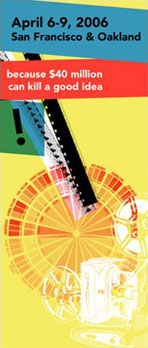
The 2006 hi/lo Film Festival Tix On Sale!
The 2006 hilo Film Festival is coming up April 6-9 in San Francisco at the Brava Theater Center and at Oakland's Parkway Theater and tickets are now on sale!
40 films about snakes, old people, movie stars, houses that float, people who live under roller-coasters and many other subjects you probably were wondering about will be on the big screen for three gloriously high concept/low-budget days in April. The screening schedule is listed below and info on the films, on the history of the festival and who puts this thing together is included on this very yellow website, so take a look around!
Don't know what high/concept low/budget films are all about?
The 2006 hi/lo films...
SHORTS PROGRAM 1 - Thurs 7:15; Sat 7:15 - Brava, SF
Profiles in Science - Wes Kim, Seattle
Lift off - Terri Timely, Berkeley
Fumi and the Bad Luck Foot - David Chai, San Jose
Space Diamonds: the Philosophy of JD 'Junior' Moore - Curtis Craven, Austin
Sprout and the Bean - Terri Timely, Berkeley
I should have been a taxi driver - Anders Osterballe, San Mateo
Totally Real TV - Brendon Lloyd, Los Angeles
Joe: Body Electric - Jack Beck, Rochester
Tales of mere existence - Lev, San Francisco
Mi Burrito Escondido - Dewayne Austin, San Francisco
Square MM of opportunity - Luke Lamborn, Syracuse
Vienna in the Desert - Wago Kreider, San Francisco
Snakeman - John Inglis, PascoeVale, Australia
SHORTS PROGRAM 2 - Fri 9:15pm; Sat 9:15 - Brava, SF & Sun 2pm - Parkway, Oakland
Let's Start Again - Charlie Tweed, London UK
Pretty Things - 'Straight for a Minute' - Michael Lucid, Hollywood
The Burger Joint - Will Pascoe, Toronto
Grand Luncheonette - Peter Sillen and Ian Kelly, New York
b-alles - Marina Gioti, Athens, Greece
To The Hills: Milk - Fritz Donnelly, New York
Heavy Soul - Oren Shai, Brooklyn
Rabid - Mike Olenick, Columbus
Bad Person - Donna Szoke and Ben Mikuska, Vancouver
Afloat - Erin Hudson, Palo Alto
Hello, Thanks - Andrew Blubaugh, Portland
Pretty Things - 'Always a bad girl' - Michael Lucid, Hollywood
Surrounded - David Politzer, Brooklyn
SHORTS PROGRAM 3 - Fri 7:15pm; Sat 5pm - Brava, SF & Sun 5pm - Parkway, Oakland
Who is Lewis - Christopher Schilz, Bochum, Germany
Backseat Bingo - Liz Blazer, Glendale
Westbound/Eastbound - Rohan Bader, Markham, Canada
Farmer Brown - Charlie Cline, Pittsburgh
Knifin Around - Ian Densford, Providence
How I Know You - Matthew Timms, Brooklyn
Bartholomew's Song - Allison Welch, Lowell Frank and Destin Cretton, San Diego
The Shins "pink Bullets" - Adam Bizanski, Haifa, Israel
Recliner Dance - Tom Gingell, San Diego
Under The Roller Coaster - Lila Place, Brookline
Spam Letter + Google Image Search = Video Entertainment - Andre Silva, Iowa Cit
A Bad Hair Day - Meesoo Lee, Vancouver
BUY THE hi/lo DVD
A compilation of films from the 2005 hi/lo festival is now available on DVD. It includes 18 films from last year's festival including Fritz Donnelly's Financial Adviceand Curtis Craven's doc on Found Artist: Gary Crom. You can see a full list of the films included on the 2005 hi/lo dvd and buy the disk online here.
+++
Killing My Lobster, the San Francisco theater and film company, is proud to present a celebration of high concept/low budget films:
the 2006 hi/lo film festival
What: the 9th hilo film festival
Where: Brava Theater Center - 2789 24th St. - San Francisco
Parkway Theater - 1824 Park Blvd. - Oakland
When: April 6-9, 2006
Showtimes:
Shorts Program 1 - Thurs 7:15; Sat 7:15 - Brava, SF
Shorts Program 2 - Fri 9:15pm; Sat 9:15 - Brava, SF & Sun 2pm - Parkway, Oakland
Shorts Program 3 - Fri 7:15pm; Sat 5pm - Brava, SF & Sun 5pm - Parkway, Oakland
TIX: Available March 5th.
$8/screening - Brava * Opening Night Screening & Party - $10
$7/screening - Parkway
$12 - Festival Pass for Brava screenings only - (Includes Opening Night Party)
Info & Questions: [email protected] or 415.558.7721
What is the hilo film festival? Or Why $40 million can kill a good idea.
Originally organized in 1997 by the San Francisco production company and comedy collective Killing My Lobster the hi/lo film festival has evolved into a major West Coast showcase for independent low-budget film makers. The fest runs in the Mission District's Brava Theater Center and Oakland's pizza & pub Parkway Theater for four nights of shorts, docs, narratives, experimentals and animations. Now in its ninth year, the hi/lo film festival continues to prove that big imaginations are more important than fat wallets. Films featured range from animations, short narratives and abstract imagistic explorations to micro-features, documentaries, and uncategorizable creations. Though in most cases they are as different and distinct as night and day, the films all belong in the same festival. They are high concept works made on minimal budgets that place ideas and creativity over imitation and slickness and each, in its own way, proves that talented, dedicated people can bring their visions to the big screen.
Media Contact:
Marc Vogl, hilo film festival organizer * 415.558.7721
[email protected] * www.hilofilmfestival.com
+++
Shorts Program 2
Fri 9:15pm; Sat 9:15 - Brava, SF & Sun 2pm - Parkway
|
Let's Start Again - Charlie Tweed, London UK - 7 min, mini-dv - if the Unabomber had a British sense of humor he might look like this...of course he'd also have to be about 16 and a lot more creative. Animals of the forests beware! |
 |
|
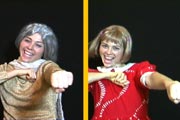
Pretty Things - 'Straight for a Minute' - Michael Lucid, Hollywood - 3 min, dv - for those times when gay guys need to go undercover it's handy to have this instructional music video. |
 |
|
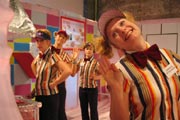
The Burger Joint - Will Pascoe, Toronto - 6 min Super 16 - on the job training in the fast food industry...with a nice beat you can dance to. |
 |
|
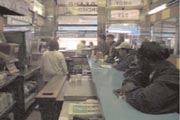
Grand Luncheonette - Peter Sillen and Ian Kelly, New York -5min, 16mm - this documentary captures the last days of a treasured Times Square diner. In a few cinematic snapshots we can taste the last of yesteryear's hot dogs and wave farewell to a time before Rudy Giuliani took the flavor out of a gritty personal urban America and made it safe to serve up Disney on every corner. |
 |
|
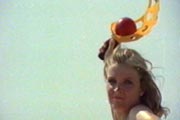
b-alles - Marina Gioti, Athens, Greece 2 min, 35mm - a 1970s commercial hyping the fun you'll have playing catch on the beach is recut and rescored courtesy of the Dead Kennedy's to create a very different sort of advertisement. |
 |
|
To The Hills: Milk - - Fritz Donnelly, New York - 3 min - mini dv - veteran hilo filmmaker ("Financial Advice" - 2005; "Boardroom" - 2003; "Instructor" and "Yoga" - 2002) returns with some sound, if sneaky, advice on what to do when you're a few cents short of replacing your roommate's milk. |
 |
|
Heavy Soul - Oren Shai, Brooklyn - 14 min, Super 16 - a stunningly stylish narrative transports us back to a time of squares and hep-cats, of juvenile delinquents and the bobby-sock girls they seduce. But this is no ordinary cautionary tale of an addicted heroine, this one takes an ugly turn that the filmmaker manages to make look oh so good. |
 |
|
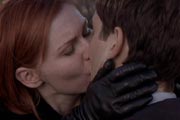
Rabid - Mike Olenick, Columbus - 11 min, found footage - Kirstin Dunst is a slut. Don't believe us? Come check out this montage to end all on-screen kiss montages made by a returning hilo filmmaker ("Son of Samsonite" - 2003). |
 |
|
Bad Person - Donna Szoke and Ben Mikuska, Vancouver Vancouver - 2 min, mini-dv - our claymated host proves that if Simon and Garfunkel recounted 50 ways to leave your lover there are a lot more ways to tell them they are a bad bad person. |
 |
|
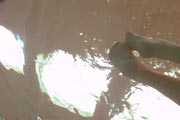
Afloat - Erin Hudson, Palo Alto - 6min, 16mm - a mesmerizing documentary featuring geriatrics and the swimming pools they love. In between the slow-moving walks through water creep heady thoughts about our own limited time in the pool of life. |
 |
|
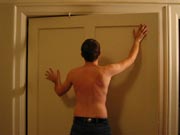
Hello, Thanks - Andrew Blubaugh, Portland - 8min, Super 16 - self-portraits are the hardest to draw and distilling your identity and what you want out of life into a personal ad is even harder, but one man and his camera still give it a shot. |
 |
|
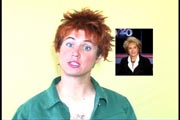
Pretty Things - 'Always a bad girl' - Michael Lucid, Hollywood - 3 min, dv -the LA sketch comedy-music-film-group recounts a brief history of famous bad girls, replete with snappy lyrics and catchy dance moves. If this isn't edutainment we don't know what is. |
 |
|
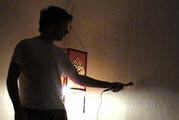
Surrounded - David Politzer, Brooklyn - 4 min, mini DV - the returning hilo filmmaker ("I Can Say It" - 2005) is woken in the middle of the night and while it takes him a moment or two to get his gear together the calls of the wild are well-recorded for our benefit. |
 |
+++
Raves for the 2005 hi/lo Film Festival:
"The Hi/Lo Film Festival has its great ideas in place. It provides a sampling of works from all around the country [and] there is an eclectic selection here that personifies what being different is. And it's worth it." - Filmthreat.com Festival Preview
"Back for its eighth year of presenting "high concept/low budget" cinema, the Hi/Lo Film Festival packs three shorts programs and two documentary features into four days of free-thinking creative combustion." - San Francisco Bay Guardian Review
"Piece by Piece gets this graffiti culture completely right, in all its ways and arguments about crews, attitudes, and whatever else is on these artists' minds." -Filmthreat.com Review of "Piece by Piece" (hi/lo 2005 documentary feature)
Great reviews of the 2004 festival starting with this nice bit of indy media analysis from Kitchensink Magazine.
Thanks to 7x7 magazine who put us in their top 5 "must-do" festivals. We're mentioned alongside the Film Arts Festival, the SF International, the Asian-American Festival and the SF Gay and Lesbian Festival.
hi/lo film festival is the SF Bay Guardian's Critic's Pick:
Proving that it doesn't take $100 million to make a decent movie, the seventh annual Hi/Lo Film Festival features three days of "high-concept, low-budget" shorts and features. There just aren't enough films out there like Roger Beebe's kitschy "Famous Irish Americans," a graphic lecture insisting that black celebrities with Irish last names really are Irish, or Judy Fiskin's "50 Ways to Set the Table," which highlights competitive "tablescaping." If you're into parodies, director Hanelle Culpepper replaces HBO's estrogen-powered coterie with curious toddlers in "Six and the City." Not surprisingly, quirky humor is a top priority in this event presented by San Francisco comedy collective Killing My Lobster, but expect smatterings of seriousness as well. Sonja Shah's "Something Between Her Hands" documents Cambodian sex-workers, and filmmaker Tom Putnam takes us on a mind trip with "Tom Hits His Head," in which a genteel office worker suffers from a nervous breakdown. Though a few works on the bill comply only with the "low-budget" part of the deal, most are good for at least a hearty laugh."
-Kimberly Chun, SF Bay Guardian, March 31, 2004
Monster Road is the SF Weekly's Pick For This Saturday Night:
"Sweatshops have nothing on stop-motion animation studios. Every second of a stop-motion film contains 24 individual shots, each of which must be painstakingly staged and lit. Consider the infinite patience it takes to produce, say, just one freaking Gumby episode, and it's easy to understand why master Claymation technician Bruce Bickford is such an eccentric. In his desolate Seattle-area home, his only friends his Alzheimer's-patient dad and those clay "little guys," Bickford has been making underground flicks in his basement for nearly 50 years. Even his best-known creation, the 1979 Frank Zappa vehicle Baby Snakes, is utterly obscure, and Bickford himself is practically a nonentity. But as Monster Road- a funny, moving cinematic biography of him -- proves, he lives an inner life so rich and bizarre that he hardly needs adulation."
> -Joyce Slaton, SF Weekly, March 31, 2004
and the SF Bay Guardian recommends Monster Roadtoo:
"*Monster Road Clay animator Bruce Bickford doesn't claim to be God, but considering he's been bringing clay figures to life for more than 40 years, the guy might as well be. Director Brett Ingram's feature-length documentary explores the intriguing, often macabre world of Bickford's art, while also delving into the artist's childhood and family background. The other major character is Bruce's father, George, a retired rocket scientist living with his son in a home studio outside Seattle. Intertwining a war-hungry U.S. culture, the Bickfords' philosophies, and the intricate beauty of claymation, Monster Road is at once a private and public history, told in a somewhat minor key. But gentle humor offsets the nostalgia and the younger Bickford's childlike inclinations prove to be just as charming to watch as his livelihood."
-Kimberly Chun, SF Bay Guardian, March 31, 2004
Raves for the 2003 hi/lo film festival
Hi/Lo Film Festival
Fri/11-Sun/13, San Francisco Art Institute
HOT DOGS OF love. That's what Killing My Lobster wants to bring you. To be precise, wieners lip-synching to Air Supply in Michelle Dean's short "Making Love (Out of Nothing at All)." Killing My Lobster, the brilliantly wiseass comedy troupe, presents the sixth annual Hi/Lo Film Festival, which celebrates the best in big-concept and no-budget pairings. Imagine if Hitchcock had two-figure funding for North by Northwest. Would he have given up right then and there? Maybe not if he knew there was a festival where folks would dig both the good idea and the fact that he had to hold up the plane himself and make whirring noises out of the side of his mouth. Alec Joler employs this exact technique in "Fast Forward 1," a massive vision of pyrotechnic action executed with Legos and human sound effects. The Hi/Lo collection of shorts revels in indie film at its silly strangest, but serious works such as Bob Hurst's "Addendum" find a place in this festival too. Hurst's ragged, uneven film about a friend dying of Alzheimer's is pulled together from the remnants of a ruined documentary. Be sure to catch Julia Sarcone-Roach's "Call of the Wild," a trippy and adorable animated flick featuring kitties, bats, a flossing walrus, and prank-calling bunnies. See Rep Clock for show times. For more information go to www.hilofilmfestival.com. (Laurie Koh)
+++
Best of the bizarre at Hi-Lo
James Sullivan
Thursday, April 10, 2003
Those who recall the early-'80s heyday of the impossibly soft pop balladeers Air Supply probably remember the duo as real wieners. San Francisco filmmaker Michelle Dean has taken the memory literally, using singing hot dogs in an absurd video of the group's smash hit "Making Love Out of Nothing at All. "
That's just one of the offerings (many of them just as bizarre) of this year's Hi-Lo Film Festival, the sixth annual celebration of independent, low- budget filmmaking curated by the sketch-comedy troupe Killing My Lobster.
Short features include a spoof of big-budget action movies, condensed into three minutes and told with Legos ("Fast Forward 1"), the strangely unconventional life of a dog walker ("Dog's Next Friend") and footage of an exploding record player ("Revolutions per Minute").
The centerpiece, screening at 7 p.m. Saturday, is "Tributary," a wry feature-length documentary about America's bustling cover-band industry. Ozzy Osbourne isn't farcical enough, apparently -- there are people out there devoting their lives to emulating him, and director Russ Forster has them on video.
Hi-Lo Film Festival, Friday-Sunday at San Francisco Art Institute, 800 Chestnut St. (at Jones), San Francisco. $7. (415) 558-7721 or www.hilofilmfestival.com.
The goofy, high-energy "24 Hour Party People" made a movie star out of Manchester, England. The industrial town has sired many of the biggest bands and trends in British pop and rock 'n' roll, including Joy Division and New Order, the Smiths and Oasis, the "Modchester" sound of the 1960s (Hollies, Herman's Hermits) and its groovy successor, the "Madchester" rave scene of the late '80s (Happy Mondays, Stone Roses).
The place is also home to Albert Finney, Anthony Burgess ("A Clockwork Orange") and soccer's beloved Manchester United, the latter lending the city its self-appointed title as the "Rock 'n' Goal Capital of the World." Since there are no San Francisco pubs named for Manchester, the Edinburgh Castle hosts an evening honoring its own namesake's neighbor, featuring film, readings and a DJ spinning five decades of Mancunian pop. (Let's hear it for "I'm Henry the VIII, I Am"!)
Manchester: So Much to Answer For, 9 p.m. Saturday at Edinburgh Castle, 950 Geary St., San Francisco. $10. (415) 885-4074 or www.castlenews.com.
Don't call it a comeback, but radical chic has had a bit of a revival in recent few years. Rappers have been calling for Black Panther-style activism, indie rockers cultivate huge Afros, and the MC5 signed a deal with Levi's.
The Black Panthers may have been iconic -- they certainly understood the powers of image and gesture -- but they were people of complexity and contradiction, like the rest of us.
Berkeley Art Museum and the Pacific Film Archive explore those complexities with their current collaboration, including a compelling photo exhibition and a film series featuring documentaries on Eldridge Cleaver, among others.
Cleaver believed that white kids would come to the Panthers' repudiation of the old white America by way of soul music. "All they know is it feels good to swing to way-out body rhythms instead of dragassing across the dance floor like zombies to the dead beat of mind-smothered Mickey Mouse music," he wrote in "Soul on Ice." Look at the current pop charts: That particular debate still rages.
"The Black Panthers 1968: Photographs by Ruth-Marion Baruch and Pirkle Jones," 11 a.m.-7 p.m. Wednesday-Sunday through June 29 at the UC Berkeley Art Museum, 2626 Bancroft Way, Berkeley. $5-$8 (UC Berkeley students, faculty and staff and children younger than 12 free). "Eldridge Cleaver, Black Panther," part of Black Panthers film series, 7 p.m. Tuesday at the Pacific Film Archive,.
+++
Still more media gushing for hi/lo
"If you've forgotten that big imaginations are more important to the creative filmmaking process than, say, Miramax's big fat wallets, you might want to take note of the Hi/Lo Film Festival."
-- www.sfgate.com
"Films that you won't find at the multiplex."
-- www.sfstation.com
"Animation, claymation, documentary and 'uncategorizable' creations grace the screen in a communal effort to spit in the face of the increasing standardization of the movie business."
-- San Francisco Metropolitan

More Background On HiLoFilmFestival.com
HiLoFilmFestival.com functioned as the official online hub for the Hi/Lo Film Festival, a distinctive independent film showcase that emerged in the late 1990s and gained recognition through the mid-2000s. While it never reached the global prominence of festivals like Sundance Film Festival or Tribeca Film Festival, Hi/Lo developed a strong identity rooted in artistic experimentation, humor, and an unapologetic embrace of low-budget filmmaking.
The festival’s core philosophy—often summarized as “high concept, low budget”—set it apart from more commercially driven events. Rather than prioritizing production value or celebrity appeal, Hi/Lo focused on originality, imagination, and the creative spirit of filmmakers working with limited resources.
Origins and Founding Vision
The Hi/Lo Film Festival was established in 1997 by members of Killing My Lobster, a San Francisco–based comedy troupe and production company known for its irreverent, experimental approach to performance and media. The founders, including Brian L. Perkins and Marc Vogl, sought to create a platform where filmmakers could showcase innovative work without the constraints typically imposed by budget expectations or industry standards.
The festival began in humble circumstances, reportedly hosted in informal screening spaces in San Francisco’s North Beach area. These early events reflected a grassroots ethos: filmmakers and audiences gathered not for prestige, but for the shared experience of discovering bold, unconventional storytelling.
From the outset, Hi/Lo distinguished itself by rejecting the notion that financial resources were essential to cinematic success. Instead, it promoted the idea that strong concepts and creative execution could outweigh technical polish or large-scale funding.
Growth and Evolution
Over time, Hi/Lo evolved into a recognized regional event within the San Francisco Bay Area. By the early 2000s, it had expanded to established venues such as the Brava Theater Center in the Mission District and the Parkway Theater in Oakland. These venues provided a more formal setting while preserving the festival’s independent spirit.
The festival typically ran for several days, featuring multiple curated screening blocks that included:
- Short narrative films
- Experimental works
- Documentaries
- Animated films
- Hybrid and uncategorizable projects
Despite its growth, Hi/Lo maintained its commitment to accessibility. Ticket prices were intentionally kept low, making the event approachable for a wide audience, including students, emerging filmmakers, and local community members.
Attendance grew steadily, with hundreds of viewers attending annually. The festival also began receiving coverage from local and national media outlets, further solidifying its reputation as a must-see event within the indie film circuit.
Programming Philosophy and Film Selection
At the heart of Hi/Lo’s identity was its unique programming philosophy. Unlike many festivals that categorize submissions strictly by genre or format, Hi/Lo emphasized a unifying principle: films had to embody a high-concept, low-budget ethos.
This meant that selection criteria prioritized:
- Original ideas and storytelling innovation
- Creative use of limited resources
- Experimental or unconventional techniques
- Strong artistic voice
The festival screened works created using a wide range of formats, including Super 8, 16mm, digital video, and even unconventional media such as found footage or handcrafted animation.
Interestingly, Hi/Lo eventually introduced a runtime limitation, focusing primarily on shorter films (typically under 30 minutes). This allowed curators to review more submissions and present diverse programming within a limited timeframe.
The result was an eclectic mix of films that could range from humorous and absurd to deeply introspective or socially relevant. This diversity became one of the festival’s defining characteristics.
Signature Style and Cultural Identity
Hi/Lo developed a recognizable cultural identity that blended humor, irreverence, and artistic sincerity. Many films leaned into quirky or absurd themes, reflecting the comedic roots of its organizing body, Killing My Lobster. However, the festival also made space for serious and thought-provoking works.
This duality—balancing humor with depth—helped distinguish Hi/Lo from other independent festivals. It embraced the idea that independent cinema could be both entertaining and intellectually engaging without conforming to mainstream expectations.
The festival’s tone was often described as:
- Playful yet intentional
- Experimental yet accessible
- Community-driven yet curated
This identity resonated strongly with audiences who were seeking alternatives to conventional film programming.
Notable Screenings and Content Diversity
Hi/Lo’s programming showcased an extraordinary range of topics and storytelling approaches. Films explored themes such as:
- Urban life and cultural change
- Personal identity and relationships
- Satire and parody
- Social issues and documentary storytelling
- Abstract and visual experimentation
Some films used humor to critique societal norms, while others employed unconventional techniques to push the boundaries of cinematic language.
The festival’s openness to diverse formats and styles made it a fertile ground for emerging filmmakers to experiment without fear of rejection based on traditional standards.
Awards, Recognition, and Critical Reception
While Hi/Lo was not primarily awards-driven in the traditional sense, it did offer recognition to standout films, including honors such as “honorable mentions.” These acknowledgments were less about competition and more about celebrating creative achievement.
The festival received praise from various media outlets and critics. Publications highlighted its originality and its commitment to showcasing films that might otherwise go unnoticed.
For example, it was recognized by regional magazines as a “must-do” cultural event, and critics frequently emphasized its role in promoting independent voices. Coverage from outlets like SFGate and the San Francisco Bay Guardian underscored its importance within the local arts scene.
Compared to major festivals such as Cannes Film Festival, Hi/Lo operated on a much smaller scale. However, its impact was significant within its niche, particularly among filmmakers and audiences interested in experimental and low-budget cinema.
Audience and Community Engagement
Hi/Lo attracted a diverse audience that included:
- Independent filmmakers
- Film students
- Artists and creatives
- Local community members
- Fans of experimental cinema
The festival fostered a strong sense of community. Screenings often felt intimate and interactive, with audiences engaging directly with the work and, at times, with the filmmakers themselves.
This community-oriented approach contributed to the festival’s lasting appeal. It was not merely an event but a gathering of like-minded individuals who valued creativity and authenticity.
Relationship to the Broader Film Industry
Hi/Lo’s philosophy positioned it as both a complement to and a critique of the mainstream film industry. By emphasizing creativity over budget, it challenged the notion that financial resources were the primary determinant of cinematic quality.
This perspective aligned with broader trends in independent filmmaking, particularly during the late 1990s and early 2000s, when digital technologies were making film production more accessible.
In contrast to high-budget studio productions, Hi/Lo celebrated resourcefulness and innovation. Its programming served as a reminder that compelling storytelling could emerge from even the most modest circumstances.
Press and Media Coverage
The festival received attention from a variety of media outlets, including local newspapers, film criticism websites, and cultural magazines. Reviews often highlighted:
- The diversity of programming
- The originality of the films
- The festival’s unique identity
Critics frequently noted that Hi/Lo offered experiences that audiences would not find in mainstream theaters. This emphasis on discovery and novelty became a key selling point.
Media coverage also helped elevate the festival’s profile, attracting both filmmakers and attendees from beyond the immediate Bay Area.
Cultural and Social Significance
Hi/Lo’s cultural significance lies in its role as a platform for underrepresented voices and unconventional storytelling. By lowering barriers to entry, it enabled filmmakers to share their work without needing substantial financial backing.
This democratization of filmmaking aligned with broader movements within the arts that sought to challenge traditional hierarchies and gatekeeping.
The festival also contributed to the cultural vibrancy of the San Francisco Bay Area, a region known for its artistic innovation and countercultural history. In this context, Hi/Lo can be seen as part of a larger ecosystem of creative experimentation.
Website Function and Digital Presence
HiLoFilmFestival.com served as both an informational resource and a promotional tool. The website provided:
- Festival schedules and programming details
- Information about venues and ticketing
- Background on the festival’s philosophy and history
- Film descriptions and filmmaker information
The site’s design reflected the festival’s personality—informal, slightly irreverent, and focused on content rather than aesthetics. It functioned as a central hub for both attendees and participants.
Although the website is no longer actively maintained, archived versions offer valuable insight into the festival’s operations and identity during its peak years.
Decline and Legacy
Like many independent festivals, Hi/Lo eventually ceased regular operations. The reasons likely include a combination of logistical challenges, funding limitations, and shifts within the independent film landscape.
Despite its relatively short lifespan, the festival left a lasting impression. It demonstrated that:
- Independent festivals can thrive without large budgets
- Creativity and originality resonate with audiences
- Community-driven events can have meaningful cultural impact
Hi/Lo’s legacy continues to influence how filmmakers and organizers think about independent cinema. Its emphasis on “high concept, low budget” remains a guiding principle for many creators working outside traditional industry structures.
Comparison to Other Independent Festivals
While festivals like South by Southwest and Telluride Film Festival have grown into major industry events, Hi/Lo remained intentionally small and focused.
This distinction highlights an important aspect of the independent film ecosystem: not all festivals aim for scale or commercial success. Some, like Hi/Lo, prioritize artistic integrity and community engagement over expansion.
HiLoFilmFestival.com represents more than just a defunct website; it is a window into a unique chapter of independent film culture. The Hi/Lo Film Festival embodied a philosophy that continues to resonate: that great ideas, executed with passion and creativity, can transcend financial limitations.
Through its programming, community engagement, and cultural impact, Hi/Lo demonstrated the enduring value of independent artistic expression. It provided a platform for voices that might otherwise have gone unheard and offered audiences a chance to experience cinema in its most inventive and unfiltered form.
In an industry often dominated by budgets and box office returns, Hi/Lo stood as a reminder that imagination remains the most powerful tool in filmmaking.